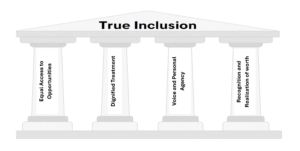
Four Pillars of BelongingPath
From presence to genuine belonging.
The BelongingPath Framework looks beyond who is counted as a member or a beneficiary. It asks whether people get fair and practical access to opportunities, are treated with dignity, can exercise personal agency and voice, and feel that their worth is recognised in everyday practice.
These four pillars are designed to be usable across settings – SHGs and federations, programmes and institutions, workplaces, classrooms, sports, governance, and families. If even one pillar is weak, inclusion remains partial. When all four are strengthened together, people stop feeling like they are “allowed to sit in the room” and start experiencing it as their space.
Equal Access to Opportunities
Opportunities are visible, reachable, and usable for everyone – not just a vocal or well-connected few.
Dignified Treatment
People are treated with fairness and respect, without belittlement, ridicule, or constant judgement.
Respecting Personal Agency & Voice
Individuals are not just present. They can question, disagree safely, and influence decisions.
Realizing Worth
People see themselves as capable and valuable, and this is reflected back by others and by the system.
How the Four Pillars Work Together
The Four Pillars offer a simple way to understand where belonging strengthens or breaks down.
Each pillar supports a different part of a person’s experience. When even one pillar weakens,
people may be present in a space but still feel hesitant, unsafe, or peripheral.
Together, the pillars help diagnose what needs attention — whether information is not reaching
people, norms are discouraging participation, voices are not being heard, or recognition is
limited to a few familiar faces. Strengthening all four pillars makes inclusion durable and
felt, not just documented.
The sections below describe each pillar, how exclusion shows up through it, and what it looks
like when the pillar becomes strong in everyday practice.
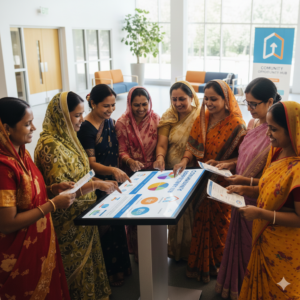
Equal Access to Opportunities
Equal Access to Opportunities means that people not only have a formal “right” to schemes, spaces, and roles, but also the information, capability, and practical means to use them.
- Core idea:
opportunities should reach every member – especially those with visible and invisible
exclusion markers – in a form they can actually act on. - Typical barriers:
information shared only with a few central people; complex or digital-only processes;
meetings at times or places that automatically exclude caregivers, wage workers, or those
with mobility constraints; norms that silently discourage certain groups from applying.
What it looks like when this pillar is strong
- Eligibility norms and procedures are simplified and explained in ways people can relate to.
- Information about trainings, roles, benefits, and schemes reaches all members, not just a few.
- Practical constraints – distance, timing, language, digital access – are actively addressed.
- Rotation and transparent selection become normal for leadership roles, exposure visits, and benefits.

Dignified Treatment
Dignified Treatment means that every person is treated with fairness, respect, and patience –
regardless of identity, background, position in the hierarchy, or personality.
- Core idea:
inclusion is not just about being let in; it is about how one is spoken to, looked at,
and engaged with during routine interactions. - Typical barriers:
belittling comments, jokes at someone’s expense, constant interruption, “explaining down”
to people, assigning only low-status work, or involving someone “for formality” but not
really listening.
What it looks like when this pillar is strong
- Groups set simple norms that clearly make ridicule, shaming, and public scolding unacceptable.
- Facilitators and leaders consciously invite quieter or less-visible members into discussions.
- Recognition is shared across people and roles, not restricted to a few “usual faces”.
- People feel they can show up as they are, without fear of insult or subtle put-downs.

Respecting Personal Agency and Voice
Respecting Personal Agency and Voice means that individuals are not just present on paper.
They can express views, ask questions, say “no”, and help shape decisions that affect them.
- Core idea:
presence without real say is not inclusion. People need room to think, decide, and influence. - Typical barriers:
decisions taken elsewhere and only “informed” later; leaders or staff speaking on behalf
of everyone; silencing dissent; or subtle punishment of those who question or use
grievance mechanisms.
What it looks like when this pillar is strong
- Decision-making spaces have room for questions, disagreement, and alternative suggestions.
- Members take turns leading discussions, presenting points, or representing the group outside.
- Leaders actively ask, “Whose voice have we not heard yet?” and give time for those voices.
- Using feedback or grievance channels is normalised, not seen as “creating trouble”.

Realizing Worth (by Self and by Others)
Realizing Worth means that people see themselves as capable and valuable – and this is also
reflected back by how others treat them, the roles they are trusted with, and the kind of
feedback and support they receive.
- Core idea:
inclusion becomes durable when people no longer doubt whether they “belong here”, and
start feeling like co-owners of the space. - Typical barriers:
ideas repeatedly ignored; appreciation reserved for a few; people confined to the same
low-visibility tasks; or constant comparison that undermines confidence.
What it looks like when this pillar is strong
- Quiet and behind-the-scenes work is recognised along with visible leadership roles.
- Members see people “like them” planning, speaking, and taking decisions.
- Simple, regular appreciation becomes part of meetings and training spaces.
- People feel confident to try new roles, propose ideas, and support others in doing the same.
Putting the Four Pillars into Practice
BelongingPath is meant to be used in real settings, not just read as a concept note.
The four pillars together give SHG institutions, programmes, organisations, and teams a
simple lens to see where exclusion is hiding, and what can change in structures, culture,
and everyday practice.
- Diagnose where access, dignity, agency, or recognition are breaking down.
- Design practical, field-friendly actions that strengthen each pillar.
- Track shifts using both numbers and lived experiances
Common Questions
What are the Four Pillars?
Access, Dignity, Agency, and Worth.
Why are these pillars important?
They show which part of belonging needs attention first.
How do the pillars relate to exclusion markers?
Markers reveal who may be at risk; the pillars show what needs strengthening.
Can the pillars be used in any setting?
Yes — organisations, schools, public systems, community groups, and more.